
This post may contain affiliate links. If you use them we earn a small commission at no extra cost to you.
Our standard approach to planning a trip used to go something like this: let's find every single epic thing there is to do. Then, with half the amount of time needed, let's make it all fit.
That usually didn't work out too well.
If you've ever tried to plan a big trip yourself you know the dilemma.
And with five insanely appealing national parks, a Utah road trip sounds like a truly epic adventure, but with so much to see, completely overwhelming at the same time.
Now, as full time vanlifers for the past several years, route planning isn't something we dabble in. It's become an aspect of daily life.
We're constantly mapping drives, balancing hours on the road with scenic stops, while planning everything around great lighting, weather, and terrain.
This seven day itinerary was built using the exact same approach we use all the time. The new approach, that is. The one where we've learned the arts of thoughtful pacing, realistic drive times, and choosing the best places to be at the best times.
Every recommendation comes from visiting these places - hiking the trails, navigating the crowds, checking for permits and timed entry requirements.
This national parks itinerary is for travelers who crave some adventure, but don't want to spend weeks piecing together information from dozens of tabs and conflicting advice.
That said, it's an ambitious route. But any plan that takes you through five of the nation's best parks, spread out across more than a thousand miles, in one week, is going to be. It's meant to be structured and efficient, without being too rigid or making you feel rushed.
Either way, the work is already done for you, so keep reading and start imagining yourself road tripping through Utah's Mighty Five.

The Best Time of Year for a Utah Road Trip
Utah is a place of extremes and we'll be covering a lot of varied terrain on this road trip. So, each season can look quite different and really have an impact on what type of visit you have.
If you're looking for the all-around best time to visit Utah, considering comfort and crowds, then September, October, or May would be the best options.
Here's a further breakdown of each season and what to expect:
// Spring (April–May): Cold mornings, with comfortable afternoons. Snow is still likely at higher elevations, but the eastern parks won't be uncomfortably hot yet. Slightly thinner crowds, but still a popular time of year.
// Summer (June–August): The busiest, hottest time of the year. Expect highs in the 80s - 100s, especially in Arches and Canyonlands. Crowds will be at their peak due to summer vacations.
// Fall (September-October): Still busy, but crowds will be thinning out and temperatures cooling down.
// Winter (November-March): Much less traffic, and beautiful views with snow covered landscapes, but some parts of the parks will be inaccessible and you need to be prepared for difficult road conditions.


Seasonality affects more than just weather.
From spring through fall, private vehicles aren't allowed in Zion Canyon, and visitors must rely on the park’s shuttle system, which can involve long waits during peak hours.
Competition for permit-only hikes like Angels Landing in Zion or Fiery Furnace in Arches will be stiffer during the spring and summer.
During late fall through early spring, daylight hours are noticeably shorter. That translates to tighter hiking windows and less flexibility for sunrise-to-sunset exploring. Summer offers long days, often 14 hours or more, making it easier to fit in more activity, but the trade-off is more heat and bigger crowds.
Next we'll take a quick glance at each of the national parks on this list to give you some familiarity, but if you'd rather skip straight to the seven day road trip itinerary you can do that instead.
Overview of the Mighty Five

Zion National Park
Zion is known best for its towering sandstone cliffs, narrow slot canyons, and a lush canyon floor that's been carved out by the Virgin River. It offers incredible views with its massive vertical walls and some very adventurous hikes - ever heard of The Narrows or Angels Landing?
It's located in southwestern Utah, near Springdale, is closest to Salt Lake City and Vegas, and is hands-down the most visited of Utah's five national parks.

Bryce Canyon National Park
Bryce Canyon sits at a higher elevation than the rest of the parks and is located in southern Utah. It has the coolest temperatures and can see snow from October through May.
Its claim to fame is a dense concentration of hoodoo rock formations - tall spires that give it an otherworldly look. It's a more compact park, but has some fantastic hiking and very accessible overlooks.

Capitol Reef National Park
This has to be the most overlooked national park in Utah, but it's a hidden gem. Capitol Reef is centrally located, though it's a bit off the beaten path. Here you'll find a blend of dramatic, rugged desert landscapes, with fertile farmland and historic orchards where pioneers found a place to settle and work the land.

Arches National Park
Just outside Moab on the eastern edge of Utah, Arches is home to more than two thousand documented sandstone arches.
Another fairly compact park, it's full of visually striking landscapes, many of which can be seen from a car or overlook. But it also holds plenty more for anyone who wants to jump on a trail and explore deeper.

Canyonlands National Park
Canyonlands is also just outside Moab, but it's much more vast and rugged. This park was carved out over time by the Colorado and Green Rivers, resulting in a landscape of countless, interconnected canyons.
Four distinct districts divide the park up, and a lot of time could be spent in each one. So, expect to see the highlights on this visit and plan to come back another time if you want to experience it to the fullest.
Driving Distances Between Parks

On this road trip you'll be covering at least 1,000 miles round trip, which will be about 16 or 17 hours of driving. The distances between each of the parks is as follows:
// Zion to Bryce Canyon, about 2 hours.
// Bryce Canyon to Capitol Reef, about 2.5 hours.
// Capitol Reef to Arches, about 2.5 hours.
// Arches to Canyonlands (Island in the Sky district), about 40 minutes.
We've planned this route to be as efficient as possible, with the heaviest driving days at the very beginning and end, so you can maximize your time on park days.
To view and save our fully detailed, interactive Google Map for this road trip, enter your email below and we'll send it to you free of charge.
It includes all the places we mention in this blog post, as well as other helpful points of interest, like gas stations, lodging options, and other nearby points of interest outside the national parks.
Seven Day Utah National Parks Road Trip Itinerary
Day One | Arrival & Zion National Park
Zion is a great place to begin your road trip, since it's close to both Salt Lake City and Las Vegas, the two most convenient starting points.
Which airport should you fly into?
Great question - and it's easy to look at the drive time to Zion and think LAS makes the most sense. But, round trip, they work out to roughly the same distance, with LAS actually being about one extra hour of driving.
The final leg back from Moab to fly home will be about four hours to Salt Lake City, or seven hours to Las Vegas.
Personally, we would lean towards SLC. But it really comes down to where you can find the best flights, in terms of price and timing. Don't stress too much on which to choose, just find the flights that work best for you.
Pick a flight to Utah that arrives in the morning. That means your first day won't be totally eaten up with driving.
After arriving and picking up your rental car, head to the grocery store to pick up food and any supplies you didn't bring along.
Note // Regarding food: we'll assume every breakfast is going to be quick and simple or on-the-go, since most mornings will start very early. We'll suggest dining options when they're convenient, otherwise you'll want to pack picnic style meals or eat while on a drive.
Top Tip // Before your trip, purchase an America the Beautiful park pass. It's the best value for your money when visiting multiple parks and will save you at least $70 on entrance fees.
Oh, and be sure to download offline maps for your whole trip because cell signal is about to get very unreliable.
Now, it's time to begin your Utah national park adventure! Plug the town of Springdale into your GPS and head that way.
Zion is a large park, with a ton to see, so we're dedicating multiple days to it. But we're going to start at the visitor center, where you can stretch your legs, use the restroom, fill up your water bottles/hydration bladders, and look around.
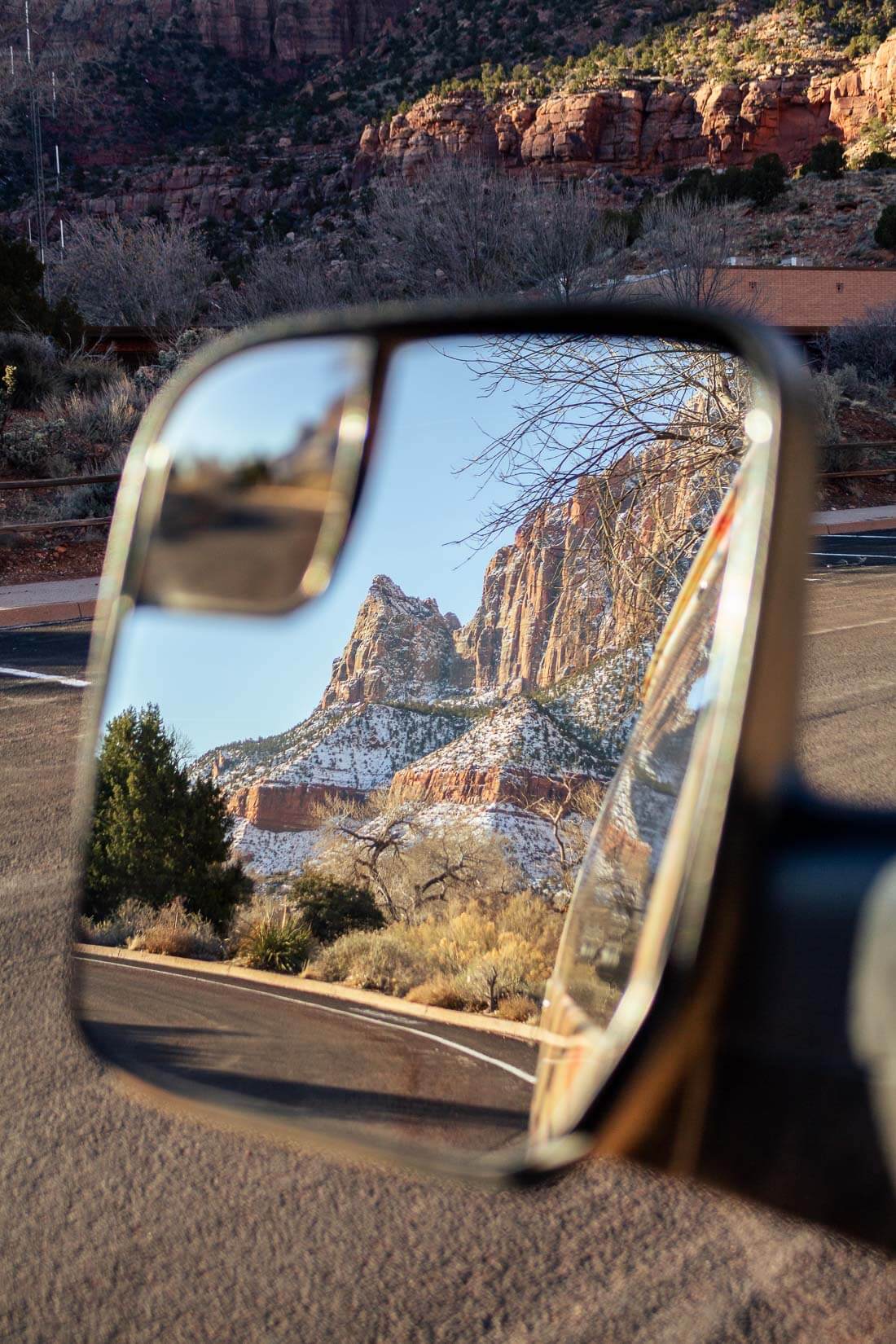
Important to Know // Since you're arriving in the late morning or early afternoon, there's little to no chance you'll find available parking at the visitor center. That's okay, because you'll just pay to park in town and take the shuttle to Zion Canyon Village.
From there it's a short walk over the pedestrian bridge into the park and the visitor center.
And then, you're going to jump on the next available park shuttle. Because in Zion, it's the only way to get into the canyon between March and November.
There are no tickets to purchase, just head over to the line for the shuttle. And refer to this NPS page for more information and a map of all the stops.

Things to Do // After a full day of travel, we're going to ease into the adventure, while still making the most of the day.
We recommend hopping off the shuttle at Zion Lodge, crossing the Virgin River on the footbridge, and making your way to the Emerald Pools/Kayenta Trail.
It's a moderate hike at 3 miles, with 580' of elevation gain, and should take around 2 hours.
When you're ready to head back into town, make a quick stop at Court of the Patriarchs for some easy, but spectacular views.
Then, get off again at Canyon Junction.
Step onto the Pa'rus Trail for a gentle 1.6 mile walk. It's a flat, paved bike/walking path that meanders along the river (the name comes from the Paiute word for 'bubbling, tumbling water') all the way back to the visitor center.
Important to Know // During shuttle season (most of the year) the last shuttles run at either 7 or 8 PM. Plan your arrival back with plenty of extra time.
Where to Stay // You have several great options in the Zion area, the first being inside the park. On the upside, you can bypass the ugly parking situation and skip some of the shuttles. The downside is you may need to book very far in advance.
The Zion Lodge is a historic hotel, that's conveniently and centrally located. There's a park shuttle stop right outside the building.
There are two campgrounds inside the park: South Campground (currently closed for rehab) and Watchman Campground. They require reservations and are budget friendly, but don't have showers. Instead, you can use the pay showers at Zion Outfitters.
Springdale has a range of hotel options. The vacation rentals here tend to be on the larger side, but a few can be found for couples or smaller parties.
And lastly, there are some fun and unique options further out, such as Under Canvas Zion or White Bison Glamping. Just be prepared to pay a premium for the experience.
Day Two | Zion & Bryce Canyon National Park
It's time to enjoy a full day in Zion, starting with sunrise. Here are our top spots:
Watchman Trail | A convenient no-brainer if you're staying at the campground. Also, it tends to be less crowded and it's close to the visitor center.
Canyon Overlook | This is going to be the most popular and crowded, but it's a short 1 mile walk from the parking area. The major downside is you'll need to drive part way up Zion-Mt. Carmel Highway (which you'll be driving again later) and then backtrack.

Things to Do // There are a few epic options in the canyon that will leave you feeling like you got the true Zion experience. It's up to you to decide which is most appealing.
Angels Landing has become one of the most well-known and popular hikes. It now requires a permit and you can try to get one months in advance or the day before. It's not for everyone, especially those with a fear of heights. But if you're prepared to do it, it's an unforgettable experience.
The Narrows is another legendary hike. It's where the canyon walls are significantly closer together and tower above you for a thousand feet. There's no marked trail and you can expect to be walking or wading through cold water.
To be prepared for this one you'll need to watch the weather for flash flood warnings and consider renting some equipment from a local outfitter.
A third alternative, just in case permits or weather get in the way, is to hike Scout Lookout. It's the first couple miles of the route up to Angels Landing, so you're guaranteed epic views. Despite being relatively short and mostly paved, it's still quite challenging.

Where to Eat // Bring plenty of trail snacks with you and a packed lunch for whichever hike you choose, and when you're done you can head into Springdale where you'll find several restaurants for dinner.
Drive // Save enough energy for the end of the day, so you can make the two hour drive down the Mount Carmel Highway over to Bryce Canyon City.
Where to Stay // Just like the Zion area, there are several lodging options near Bryce Canyon. You can stay inside the park at the Bryce Canyon Lodge or one of the primitive campgrounds, Sunset (seasonally) or North Campground, for $30/night.
In town, you have a few hotels to choose from, as well as a private RV park.
And the area is surrounded by National Forest, which makes a great option for boondocking, when the roads are accessible and dry.
Day Three | Bryce Canyon
There are a couple reasons we want to start the day in Bryce Canyon early. The first is because sunrises here do not disappoint.

No lie, when we stayed in the area we got up every single morning to catch sunrise and it was amazing each time. There are several viewpoints to catch first light over the amphitheater, but if we had to narrow it down we'd choose either Inspiration Point or Bryce Point.
The other reason to be in the park in the morning is because, once again, parking can be difficult. If you arrive after 9AM, you'll probably want to consider taking the shuttle.
Things to Do // Hike Queens Garden Trail & Navajo Loop. It's like the greatest hits collection of the canyon and you'll see the hoodoos up close, including some of the most iconic formations. If Wall Street is open (it depends on the season), you can see it by completing the full Navajo Loop.
Top Tip // While 3 miles of hiking may sound modest, Bryce Canyon sits at a higher elevation than the other parks. You'll be starting at 8,000 feet and clocking some uphill miles. Don't underestimate the extra work your lungs will be doing, and remember to hydrate.

Take the main park road south to Rainbow Point (or as far as road conditions will allow) for a scenic drive. Plan at least one hour for the full drive and add time for stops along the way. Natural Bridge, Agua Canyon Overlook, and Yovimpa Point are some of the best.
Enjoy a picnic lunch somewhere along the route, before heading back north and stopping at the visitor center on the way out.
If you want an optional, easy hike before leaving you can do Mossy Cave Trail. It's only 0.9 miles and 151' of elevation.
Where to Eat // There are a few dining options in Bryce Canyon City or you can wait until you get to Torrey, near Capital Reef.
Drive // You've got another evening drive, about 2.5-3 hours over to Torrey, where we'll briefly set up a homebase to explore the next park.
Where to Stay // This is where renting a campervan or RV will really come in handy. Being more remote, Torrey and the surrounding area are great for campers and boondockers.
Other lodging options are available, they're just a bit more limited than other towns. For specific free camping options near Capitol Reef, download our custom Google Map above.
Fruita Campground inside the park is a paid option at $25/night. It is, however, in high demand and reservations are required. They open six months in advance, so you'll need to be on top of that.
Check Booking.com for the best hotel options either in Torrey or in nearby Caineville.

Day Four | Capitol Reef National Park
Capitol Reef is actually a massive park, second among the Mighty Five to Canyonlands. But the vast majority of visitors will only see a small portion of it.
That's fine, because some of the biggest highlights are condensed into a relatively small area along Route 24. That's what we're going to focus on for this itinerary, but we'd highly recommend looking into the Cathedral Valley Drive and greater Hanksville area if you ever have more time here.
Things to Do // Most of the day here will revolve around Fruita. It's the historic Mormon settlement central to the park, and it's like a little oasis in the desert.
Stop by the visitor center and then hustle on over to the Gifford Homestead. That's where you'll find a small house where they sell locally made fruit pies and a few other goodies. Take it from us: they're good enough to go back for seconds, but they sometimes sell out pretty quickly.


Fruit is a big part of the history here, if you hadn't guessed by the name.
The pioneer settlers established orchards of cherries, apples, apricots and peaches that are still thriving here. When in season, the orchards are open during the day for you to come and pick ripe fruit. Everything you need is there, including ladders, pickers, a scale, and self-pay station.
Spending a relaxing morning or early afternoon here among the orchards and along the river is a great way to enjoy lunch and take a break from the fast pace so far.
When you're rested, hop in the car and drive further down along the scenic drive. At the end, you'll find the Capitol Gorge trail, which leads out to the Pioneer Register, a canyon wall with hundreds of names inscribed on it, dating back to the 1880s.
More stops to make are Cassidy Arch Trail, the Hickman Natural Bridge, and the historic schoolhouse, cabin, and petroglyph sites along Route 24.


Important to Know // The Capitol Reef area is known for severe flash floods, particularly on summer afternoons. Because of how remote it is and a lack of cell phone coverage, it's important to understand the risks and check the weather the day of your visit.
Where to Eat // For sit down dining in Torrey we'd highly recommend Rim Rock Restaurant. The town has also become home to several good food trucks, if you're in the mood for something more casual.
Where to Stay // You've earned a day without a long drive. Spend a second night in Torrey or Caineville.
Day Five | Arches National Park
This morning you'll start with a 2.5 hour drive over to Arches National Park.
For the super ambitious among you, particularly photographers, you could consider a sunrise stop at Factory Butte or an early morning hike to Long Dong Silver. Neither is national park related but, in our opinion, they're just too good to pass up, and you'll be driving right by them.

Also along route is the town of Green River, which makes a good place to stop and re-supply on food or any supplies you need at this point in the trip.
The visitor center is just inside the entrance station for Arches, so stop here, stretch your legs, and fill up on water.
Things to Do // Drive out to The Windows Section, where you'll also find Double Arch, one of the most impressive formations in the entire park. It's about a 30 minute drive from the entrance and there are lots of short stops along the way. One of these would make a good place to take in the views while having lunch.

Feel free to linger around the Windows and venture over to the Garden of Eden, an often overlooked area where you can freely explore around the red rocks.
Important to Know // The Moab area is home to a large concentration of cryptobiotic soil crusts, which are incredibly fragile communities of living organisms that form a crust-like layer over the ground. They can take centuries to come back after being damaged, so it's very important to always watch your step, obey signs, and stay on marked trails or solid rock.
The last stop of the day is at Delicate Arch for sunset. It's only a 6 mile drive, but it's incredibly popular and the hike up is a bit strenuous, so it doesn't hurt to leave plenty of time.
Sitting here in the hushed silence as a crowd of people watched the light fade on Utah's most iconic rock formation is one of our favorite memories from our time in Arches. It's truly a must-do.

Where to Eat // Either eat a light meal before hiking up to Delicate Arch or bring some trail snacks and then head into Moab for a proper meal. There are plenty of restaurants in town to choose from.
Where to Stay // Once again, boondocking options are plentiful around this area, so having a campervan will almost pay for itself.
Devils Garden Campground, the only one inside the park, makes a great option given its proximity to the next day's hikes. You will need to secure a reservation well in advance, though.
Otherwise there are several other campgrounds outside the park and an abundance of hotel options in Moab.
Day Six | Arches & Canyonlands National Park
If you stayed inside the park on night five you won't have far to travel. Otherwise, get up bright and early to enter the park before the sun comes up.
Things to Do // Catch sunrise from Panorama Point, where you'll get a stunning, elevated view of nearby formations like the Windows and Balanced Rock, with the La Sal Mountains off in the distance.

From there, continue on to the Devils Garden Trail. This is an 8 mile loop, with 1158' of elevation, and some scrambling, so it's considered challenging. But, it's a big bang for your buck trail. You have the opportunity to see eight major arches, including Landscape Arch, Double O Arch, and Navajo Arch.

The northern side of the loop is almost completely lacking shade, has some deep sandy areas where it's tough to walk, and doesn't feature many arches, so if you're not feeling it, don't push yourself. You can easily make the Devils Garden Trail a 5 mile out and back to Double O Arch and still see most of the highlights.


Top Tip // Get an early start on hiking to beat the heat. The day time temperatures can get very intense in Arches and the sun feels especially harsh at 5,000 feet. Bring plenty of UV protection, in the form of lightweight clothing, hat, sunglasses, and sunscreen.
Alternative: the Fiery Furnace area can only be hiked on a ranger guided tour or by securing a permit. You can try to get those one week before your visit. Fiery Furnace is a very unique experience, where you're navigating a maze of passageways with many possible routes and dead-ends.
It's absolutely possible to get lost, so we'd strongly recommend the ranger guided tour. But it's one of those bucket list hikes, where if you can get the permit, you should totally go.
You'll spend the rest of the day exploring our final national park: Canyonlands.
Most itineraries would probably have you hop over to the closest district and end it there.
We're suggesting something a little more ambitious.
Stop for lunch and then immediately head down Route 191 to the Needles District. It'll take 1.5-2 hours, but we think it's worth it to see more of the park.
Things to Do // There are several quick and interesting stops along the way, including Wilson Arch, the Newspaper Rock petroglyphs, the Needles District visitor center, and Pothole Point, especially if there's been any recent rain.

Your final destination for sunset is Big Spring Canyon Overlook.
The Needles area is unique not only because of the namesake rock spires, but also because it's more rugged and remote. Here you can enjoy a quieter experience and slow down a little, compared to the other parks.

Where to Stay // Since you came this far, we'd suggest spending a night at one of the campgrounds close by. Those are Needles Campground or Hamburger Rock Campground, both primitive, and reservable online. Needles Outpost is a third option that's a private campground and a bit more expensive, but it has showers and flush toilets.
If you need to return to Moab to stay at a hotel, go for it. You'll be driving back up that direction soon, anyway.
Day Seven | Canyonlands & Return
The final day of your Utah national park road trip needs to end on an epic note.
Make your way to Green River Overlook, in the Island in the Sky District. The views here are absolutely mind-blowing.
You'll have seen some really impressive things on this drive through the Mighty Five, but we think it's fitting to sit here at the overlook on your final morning with a cup of coffee and just contemplate how incredible these landscapes really are.

It would probably be silly for us to not suggest Mesa Arch at this point, since it's right down the road and one of the most popular sunrise spots in the entire state. In full disclosure, though, we actually skipped this stop ourselves because of just how crowded and popular it's become.
Now, the only thing left to do is navigate back to whichever airport you're flying out of. From Moab, it's about four hours to SLC and about 7 hours to LAS. Note the time zone change if you're going to Las Vegas.
Packing List
// America the Beautiful pass
// Downloaded offline maps
// Power bank
// Refillable water bottle and/or hydration bladder
// Wide brim hat/baseball cap
// High SPF sunscreen
// Sun hoodie/UPF clothing
// Sunglasses
// Sturdy hiking boots
// Daypack
// Headlamp
// First aid
Have More Time?
If you've got more than seven days, here are a few recommendations on what else you should see and do along this route.
Valley of Fire State Park
This is one of the most impressive state parks we've ever been to and if you're flying in/out of Las Vegas you should definitely make at least a quick stop here.
It's not too far off the main route to Zion and could be seen in a short amount of time. We only spent one afternoon here and have been wanting to go back ever since.


Hanksville
This is honestly one of our favorite parts of the country. Every time we come through here it reminds us just how incredible and diverse the landscapes can be within the United States.
We used to think we had to go to distant places like Iceland just to get these views.
If you have the time, take a day to linger in Hanksville. It's where Utah starts to feel like a different planet.

Cathedral Valley Loop
We spent a couple nights slowly making our way around the Cathedral Valley Loop, but it could also be done in one day.
A warning though: it's not a run-of-the-mill scenic drive. It's a 4x4 route that actually begins with a small river crossing. You should only attempt it in good weather and be fully prepared to rescue yourself if needed. If you're using a rental car, it may be outside your comfort zone.
The good news is there are tour companies who will take you out for the day, and we've written a comprehensive guide on the whole thing.

Goblin Valley State Park
The unique mushroom-shaped hoodoos of Goblin Valley are one more landscape in the Hanksville region that will blow your mind. It's not far off the main route between Capitol Reef and Arches, so you could slip in for the day on the way there or back.
Grand Staircase Escalante National Monument
Grand Staircase Escalante is a sprawling and rugged section of southern Utah that could become a week-long itinerary of it's own. But, you'll be skimming the northern boundary on the way between Bryce Canyon and Capitol Reef.
If you want just a taste of what it has to offer, stop by and hike Lower Calf Creek Falls.
Planning to road trip through Utah? Save this post for later!

Ready for some adventures in Utah? Check out our guides:


Some of the links found on our website are affiliate links.
As Amazon Associates we earn from qualifying purchases. We may also receive a small commission at no extra cost to you through other links. Using them is a way of supporting us, helping us offset the cost of running this website, and ensuring that we’re able to continue providing free content and resources.
That makes y’all totally awesome and we truly appreciate the support!
If you've found value in our guides, you can say thanks with a virtual coffee.


Lorem ipsum dolor sit amet, consectetur adipiscing elit. Suspendisse varius enim in eros elementum tristique. Duis cursus, mi quis viverra ornare, eros dolor interdum nulla, ut commodo diam libero vitae erat. Aenean faucibus nibh et justo cursus id rutrum lorem imperdiet. Nunc ut sem vitae risus tristique posuere. uis cursus, mi quis viverra ornare, eros dolor interdum nulla, ut commodo diam libero vitae erat. Aenean faucibus nibh et justo cursus id rutrum lorem imperdiet. Nunc ut sem vitae risus tristique posuere.
Delete